Help Support the People of Puerto Rico

Posted by Coulter Sunderman on

To our community-

We recently made a new friend, Gabriel at Maquina Coffee Roasters, by bonding over really good coffee-- Honduras El Filo. Ours is produced by Miguel Moreno, his by Olvin Moreno. Really good coffee has been bringing people together for hundreds of years. Coffee is ingrained in the human experience. At H+S we create this fundamental experience for our customers by roasting coffee to its highest experiential potential. It helps the bond.

Roasting coffee well isn’t enough, however. A critical function of our business is buying green coffee. What good is bonding with another person over coffee, if the coffee itself wasn’t sourced from people who themselves are closely bonded? In other words, we must make every effort to ensure the coffee we buy has come from a source where people are happy, engaged, and able to prosper from their work in creating this magical coffee experience. We, in turn, share those stories with our customers to create a bond between them and our farmers and producers. Every time a customer drinks a cup of our coffee, they have made a tangible and actionable contribution to a family on the other side of the world.

The people of Puerto Rico were devastated by Hurricane Maria. Puerto Rico is a coffee producing country, and was at peak harvest when Maria changed the landscape and leveled almost everything. Our colleagues who have families in Puerto Rico have reported 100% crop loss, and utter devastation.

We are bonded to our community in Puerto Rico through coffee, and through our new friendship with Gabriel. Other Puerto Rican colleagues of ours have also pointed us in Gabriel’s direction for making a direct and actionable contribution to help a family in dire need.

Friday, September 29th is International Coffee Day, and it is also our last farmer’s market of the season in downtown Laramie. From Friday through Sunday, October 1st, we will donate 100% of retail bag profits from our farmer’s market, and all online sales, to Gabriel’s GoFundMe campaign. We encourage our community to join us Friday and through the weekend to support this cause.


Make a direct donation to Gabriel’s GoFundMe:

https://www.gofundme.com/family-hurricane-maria-relief

Donate to help all of Puerto Rico through United for Puerto Rico:

http://unidosporpuertorico.com/

Read more →

New Release: Ethiopia Yukro

Posted by Coulter Sunderman on

Ethiopia Yukro

What makes Ethiopian coffees so great? Complexity and intensity come to mind. Wild flavors. Juicy notes. Floral aromas.

Yukro checks those boxes in a very transparent and straightforward way. Its dry fragrance is juicy, its wet aroma is floral; flavor notes are a small range and not very complex, but crystal clear: ginger, nectarine, peach. Sweetness is simple and slightly caramel. Body is nearly completely absent, a taste ends just as quickly as it begins. A rush of bright, clean ginger into peach, finishing sweetly and cleanly. A great Spring and Summer coffee.


Green Coffee Information

Importer Red Fox Coffee Merchants
Region Agaro
Woreda Rugento
Union Rugento
Varietal Heirloom
Altitude 1900-2100 masl
Process Washed


Green Sample Analysis 2017.04.25

Sample state / size spot / 210.8g
Green moisture content 10.7%
Green density 0.691g/ml3


Tasting Notes

Trade partner notes yellow nectarine, fresh ginger, dark honey
Sample cupping notes 2017.04.26 ginger, green / white tea, floral, complex, slightly dry, delicate. Possibly a good candidate for the lavender project. Stellar complexity.
Production cupping notes 2017.06.08 fresh ginger, nectarine, peach, peach tea, sweet, clean, bright, intense. Complex in its individual traits.


Roast Profile 2017.06.05

Washed process Ethiopian coffees are generally very straightforward to roast. And because of their inherent complexities, different roast styles can and will yield very different cup tastes. In this case, our sample roast and initial production roasts were very floral, with caramel body, and very dry. Shortening the yellow stage as well as the development stage led to the intense ginger and peach takeover on the flavor notes. The acidity is now dominant to the floral character, and the cup is clean and finishes clear. "Transparent" is a great way to describe this coffee's overall impression. This is our version of a standard declining RoR profile, with a shorter development time and percentage than usually utilized.

Machine Diedrich IR-12
Roast duration 11:03
Finish temp 406.8 F
Development time 109s
Development time ratio 16.4%
Weight loss 13.05%

Roast profile

Read more →

Nitro Coffee Guide: (Method Update)

Posted by Coulter Sunderman on

Nitro Coffee

We've been selling draft nitro coffee for two years now, and with this added experience we decided to update our very popular blog post on the subject. Here's the original, where we cover more theory about what makes a good nitro coffee.

We are up to around 10 gallons per week and have changed up our flash-chilling method. Instead of the immediate chill coming out of the brewer, we now brew into regular airpots and transfer the coffee from those into the keg. The previous coil-design was using too much ice and was a bit leaky. It was a great protype for a custom all-stainless solution, which we may look at again in the future. In the meantime, this method works very well.

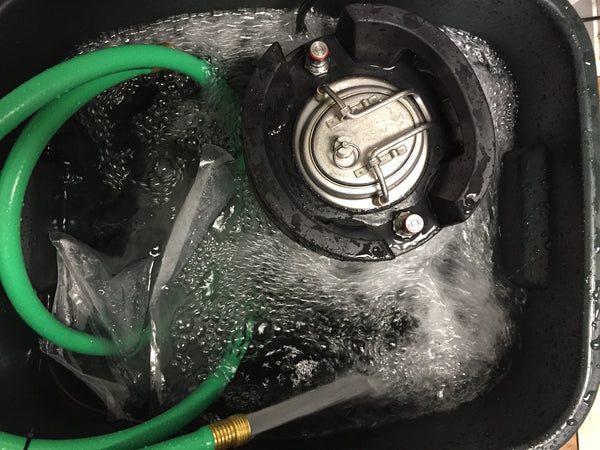
The keg is now immersed in a large plastic bin with a circulating pump. As we add coffee, we raise the level of the immersion bath, and occasionally add ice or saline bags that we've frozen. In between adding batches of hot coffee we seal the keg up. We use corny kegs.

Corny keg immersed in large circulating water bath

Once the keg is filled -- 18L total off our two-headed Fetco @3L per batch -- we purge the air and replace with nitrogen, and give it another 20 minutes or so in the water bath. We then pressurize the keg, give it a good shake, and finish conditioning in the fridge for about 18 hours.

When following the rest of the instructions in the original post, what comes out of the tap is just as tasty, maybe a bit better even. It's a very consistent process, and we hit our target TDS of 1.55 with very little variation. The cascade and head are just as strong, and we are looking at around a 2 week lifespan for the keg (we need to do a little more thorough observation on this).

We continue to observe that high-acid coffees tend to present themselves a bit better. That said, our Sweetwater Blend has been consistently good all Summer long and sees strong sales. We target it around a medium profile with maximum sweetness. Our favorites have been our Ethiopia Guji Uraga with its very complex flavors, and the Colombia Celia Congrejo which comes off with a very punchy acidity similar to a peach lemonade.

As always, feel free to contact us if you want to talk about your nitro project!

Read more →

Nitro Coffee Guide: How we do it

Posted by Coulter Sunderman on


UPDATE: We've updated this guide with our current method -- check it out right here!
Quick version: We ditched the coil and are chilling in an immersion bath.


Nitro coffee is so hot right now - and with good reason. The addition of nitrogen to a cold coffee does wonders for its texture, mouthfeel, and an impression of creaminess. It puts back in what is often lacking in cold coffee - body and mouthfeel. It's also beautiful -- a gentle cascade of tiny nitrogen bubbles, and a thick, micro-foam like head give the drinker a positive impression before they ever take a sip. And that sip, contrasted against other cold-coffee methods, can be downright sublime.

There are a lot of questions out there surrounding how to make nitro coffee, so we thought a guide might be helpful to some. This is how we make our nitro coffee, and some of the hurdles we had to overcome to create it.
Please note,  because of our altitude and a boiling point of about 198F, we use slightly lower brewing temps and ratios than SCAA standards, which are set at sea-level.

Heavy cascade, thick head. Nitro the H+S way.
 

Brew Method
First, a word on brew methods. Coffee has a "fingerprint" from when the seed gets planted, all the way through the finished cup, and each step in the process can only take away from that fingerprint. As a roaster, we keep that in mind as one of the last links in the chain between the seed and the cup. We try to roast our single origins to highlight that fingerprint and try prevent diminishing it as much as possible. Likewise, when brewing our nitro coffee, we want to keep as much of that fingerprint intact. And that means brewing hot.

Brewing hot - advantages

  • Brewing coffee hot provides a much larger flavor matrix -- one that encompasses acidity, sweetness, body, and many other sensations on the palette. Brewing hot allows acids to present beautiful, clean, sparkling qualities to the cup.
  • Brewing hot allows a higher ratio of water to coffee to hit the same target TDS as cold brewing, making it more efficient from the perspective of coffee usage (although time & labor make hot brewing less efficient from that perspective).
  • Brewing hot allows easier paper filtering -- something we have found to be incredibly important for a good nitro coffee. More on this later.

Brewing hot - disadvantages

  • Time & labor - brewing hot is much more time and labor intensive than cold brewing.
  • Scale - how do we scale this up for large production runs?
  • Cooling down - we need cold nitro coffee!

Brewing cold - advantages

  • Scale - cold brewing can be done one a large scale very easily. Giant advantage. We could brew a 5 gallon keg of cold-brew in a tenth of the labor time as brewing hot.
  • Speed - set and forget. Coffee goes in a cloth filter bag. Add water. The next day, pull out the filter bag. The cold brew is ready!
  • Equipment - a bucket, a lid, and a filter.
  • Already cold - and that's what we want, right?

Brewing cold - disadvantages

  • Flavor matrix - as we stated, we don't cold brew because we just miss a lot of the compounds which only get extracted with hot water, and therefore the potential array of flavors.
  • Ratio - it takes a lot more coffee to water to produce a cold brew that's worth drinking. We've found a TDS of roughly double the SCAA recommended (2.5-2.7 TDS) produces an acceptable cold-brew. We hit that with ratios between 1:8 and 1:10 depending on time/temperature. We also went as low as 1:5 in pursuit of ultra-big bodied cold brew.
  • Filter method - While cloth filtering is easy, it allows a bunch of superfines and, most importantly - oils, into the finished beverage. And because of high ratios, there's more of those than in a standard hot extraction, and that alters the flavor dynamic of the coffee. So why not paper filter cold-brew? Because it takes forever, that's why. Superfines from cold-brew will plug up a paper filter to a very slow drip. (We went so far as to try a paper filter with pressure via an aeropress. I'm sure there are better methods out there!)
  • Balance - cold-brew is unbalanced. How often have you sipped one and thought, "somethings missing"?

A word on oils and superfines, and the biggest reason we paper filter:
Oil breaks head retention.
When we were developing our nitro aspirations, we sought insight from a local brewmaster. He helped us a TON throughout the process. One of his biggest insights was that oils disrupt the formation of that classic "nitro head." This tidbit would later unlock the revelation that we needed to paper filter our coffee to get as much of those oils out.
This is one of the key aspects of H+S nitro coffee. You will get a beautiful, thick, creamy head if you paper filter for nitro coffee.

Our brew method:
Okay, we've gone over a lot already. Let's tie it together a bit better by going over the proof-of-concept equipment we used to unlock great nitro coffee.

  • Brewer - anything that can provide a stable, consistent temperature. We used a Fetco CBS 2031, single group 3L brewer.
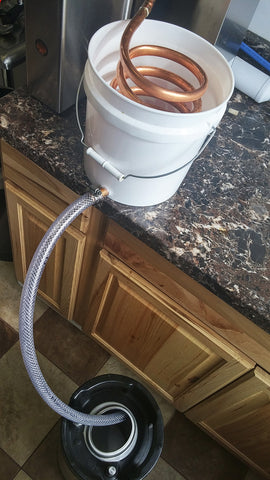
  • Flash chiller - we have to get that hot coffee cold as fast as possible. Enter a piece of beer-brewing equipment: the wort chiller. There are a variety of wort chillers and flash-chilling styles that seem to work well for coffee. We like the idea of the counterflow chiller, but for our experiments we built an "inverted immersion chiller" -- coffee runs through a copper coil which is immersed in an ice bath. The coil is gravity-fed directly from the bottom of the brew basket, through the coil in the ice bath, and directly into the keg.
The whole setup. "Inverted immersion" wort chiller, aligned with the bottom of the brew basket.
The bucket will be filled with ice and water around the coil.
  • Keg - at our small scale it seems like a Corny keg is ideal. The ability to prime the nitro though the coffee and allow air to escape via the release valve will the keep coffee flavor stable for longer. We don't have experience with nitrogenating Sanke kegs.
  • Nitrogen - 100% nitrogen is required. Beergas will not work. CO2 is the enemy of brewed coffee and introducing it into the coffee will spoil it instantly. Carbonated coffee is full of Carbonic acid, which is bitter and awful in conjunction with coffee. Stay away!
  • Stout faucet - We've actually not tested with a traditional faucet, so we can only say we've used a stout faucet with a restrictor plate with fantastic results.

Brewing a full keg

  • Ratio - cold coffee and hot coffee imbue a different perception on the palette. All those compounds taste different at different temperatures. So we don't really know what the "ideal" extraction strength is for flash-chilled coffee, besides which taste is completely subjective. But we have a feeling that a slightly stronger extraction tastes slightly better when flash-chilled, so we use around 1:14 ratio for our brewing and a target TDS of 1.45-1.5
  • Temperature - Brew at the same temperature you would hot coffee. The flash-chilling device we built took coffee from 195 to about 70 degrees across the duration of one batch (3L output).
Brewing - we do six batches of this for a full keg. Labor of love.
  • Conditioning - Once we have a full keg, it's time to prime it for serving. To do this, introduce nitrogen at a very light pressure (2-3 psi) though the Corny keg outlet valve. Open the safety valve to let air out while nitrogen is going in. Because nitrogen is lighter than air, our hope is that applying the nitrogen though the bottom of the keg will help air escape via the safety valve. After a few seconds, close the safety valve and continue to introduce about 30-40 psi, via the outlet valve, into the keg. Now the keg is conditioned. Rock the keg across your knee about 20 times, and the keg is ready for the final chill.
  • Serving - Once the keg has finished cooling to 35-40 degrees, it's ready for serving. Hook up the keg lines to the correct valves this time, then serve via a stout faucet. The hot brewed, flash chilled, nitro conditioned coffee will have a huge amount of flavor, added mouthfeel and body due to the nitrogen, and will look fantastic with a full cascade and a thick, creamy head.
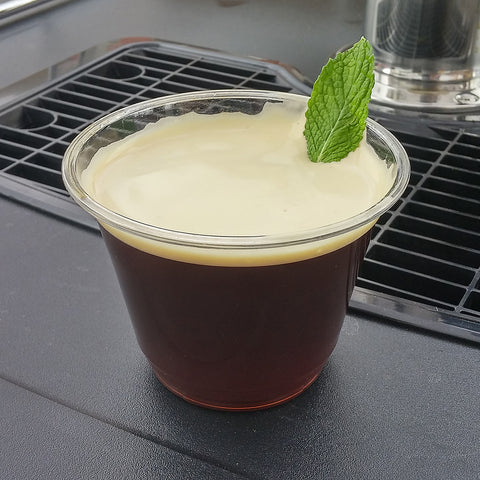
Our Kenya Nyeri Karogoto, with intense mint notes, served with a mint leaf.

A video posted by H+S Coffee Roasters (@hscoffee) on

Worth it!

Read more →

New Coffee Offerings

Posted by Coulter Sunderman on

It has been an exciting couple of weeks around the coffee roastery.

We received a new shipment of coffee which contains some incredible offerings. Here we are going to profile a few of them. Read on for more details about the terrior and history of some of these amazing regions of the world.

We've also just launched our coffee subscriptions -- choose the frequency, bag size, and duration of your desired subscription and we will take care of the rest. Subscriptions make great gifts -- who doesn't want hassle-free coffee delivered right to their door a few times a month?

Lastly, our Holiday Blend is ready for prime time! We developed a rich, chocolaty, and festive blend with that touch of cranberry sweetness that is sure to keep you warm this Winter.

Rwanda

Lake Kivu - Nyamyumba

Lake Kivu is probably our favorite region in Rwanda. The climate of the lake and the volcanic soil come together in a magical way to develop incredible flavors in these lovely coffees. An added bonus: this coffee is certified organic and FairTrade (although we don’t advertise these programs), which is somewhat rare for African coffees. This coffee comes from the COOPAC regional cooperative, which has implemented numerous systems for sustainable farming as well as community development.

Tasting Notes

Raspberry, green grape, grapefruit, turbinado sugar sweetness, crispy, clean juicy, smooth


Colombia

Tolima - Regional Select

Farmers in this region have slightly larger farms than most in the south, sometimes 10-15 hectares of land. They pick, pulp, ferment and dry their coffee on raised beds with parabolic covers. They tend to work similar varietals, some old, some relatively old and some new but the style is pretty much the same.

We think that the terroir or soil, sun weather and placement on the planet contribute largely to the flavor of these coffees when picked ripe and handled properly. So these coffees are selected by cup and then blended together like a Rhone wine or a local honey that comes many fields in a 4 mile radius.

The result is a cup with an incredible depth of flavors that we haven’t seen before in a Colombian coffee. The array of sensations between body, flavor, smoothness, and acidity is truly sublime.

Tasting Notes

Sweet aromatics, candied strawberry, maraschino cherry, creamy, smooth body


Kenya

Kiruga Othaya

This is one of two coffees we currently have from Kenya, both of which carry cupping scores over 90 points (an incredibly high score).

The meticulous attention paid to the sorting and processing of this coffee really shows. Prepare for one of the cleanest cups you have ever tasted, with a balance between sweetness and acidity that adds complexity to the incredible flavors.

Tasting Notes

Tangerine, tart cherry, strawberry, juicy, balanced, crisp, clean, complex


Sulawesi

Tana Toraja

Typical and atypical. Indonesian and Dutch. Historical and new. This offering from Sulawesi is a myriad of apparent contradictions, which makes this one of the most creative and interesting coffees we’ve ever encountered. The Arabica-Typica varietal of this coffee was first introduced to Sulawesi by the Dutch in 1750. This particular lot is a hybrid, and very atypical for coffees found in Indonesia. However, the terrior of the region has its influence on the coffee and the result is an amazing amalgamation of flavors. We think anyone who tries this offering will find something to enjoy, and be appreciative of how varietal, terrior and processing can have such creative impacts on the cup.

Tasting Notes

Peach, chocolate, sweet, full bodied, rich, savory, umami

Read more →
  • 1
  • 2
  • 3